The history of Italian surnames
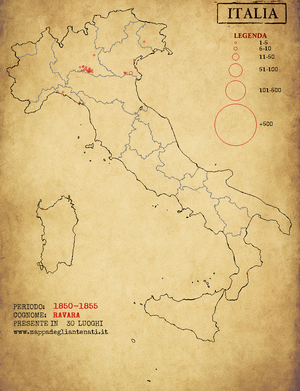
The maps on this site show how surnames moved over the centuries. To read them well, it helps to know when surnames were born and in which records they were written down, because those very records are what allow us to trace our ancestors today.
From ancient Rome to the Middle Ages
In Roman times free men bore three names: the praenomen, similar to our first name; the nomen, which identified the wider family and was the true ancestor of the surname; and the cognomen, which began as a nickname and was later used to distinguish the branches of a family.
With the end of the Empire this system disappeared. For centuries people were known by a single name, followed when needed by their father's name, their place of origin or a nickname.
The birth of surnames
Between the 10th and the 13th centuries the population grew, towns flourished again and notarial deeds multiplied. A single name was no longer enough to tell people apart: noble and merchant families were the first to adopt a hereditary surname, and the custom slowly spread to everyone else. Even in the 15th century, the tax records of many towns listed part of the population only by first name and father's name.
Surnames arose in four main ways:
- from the name of the father or founder of the family (Di Francesco, Di Matteo, Martini, Bernardi);
- from the place of origin (Lombardi, Piacentini, Genovese, Dal Colle);
- from a trade (Ferrari and Fabbri, meaning smiths; Barbieri, barbers; Sartori, tailors; Molinari, millers);
- from a nickname describing appearance or character (Rossi, red-haired; Biondi, blond; Bassi, short; Grassi, stout; Mancini, left-handed).
This is why many surnames arose independently in several parts of Italy: a Ferrari from Emilia and a Ferraro from Campania may share no ancestor at all.
The Council of Trent and parish registers
A turning point came with the Council of Trent (1545-1563), which required parish priests to keep registers of baptisms and marriages. The Rituale Romanum of 1614 added registers of deaths and the status animarum, true censuses of the families in each parish. From then on surnames were written down regularly and passed on consistently.
Parish registers are the main source for anyone looking for ancestors who lived between the 17th and the 19th centuries. They are kept in parish and diocesan archives.
Civil registration
With Napoleon, at the beginning of the 19th century, civil registration was introduced: births, marriages and deaths began to be recorded by the municipalities. In southern Italy the civil registers run continuously from 1809, while in other states, after the Restoration, registration returned to the parishes for some decades. In the Kingdom of Italy civil registration became uniform across the country from 1866.
Many of these registers are kept in the State Archives, and a large number can be viewed free of charge online on the Portale Antenati of the Italian Ministry of Culture.
Conscription lists and censuses
After unification, every municipality drew up each year the conscription lists of the young men born in the same year, with first name, surname, father's name and often trade and physical description. They are a valuable source because they cover almost the entire male population. National censuses began in the same period, the first in 1861.
The surname today
Today, under Italian law, a wife keeps her own surname after marriage. Since 2022, following a ruling of the Constitutional Court, children receive the surnames of both parents, in the order the parents agree on, unless they agree to give only one. The maps of the coming decades will tell this change too.
| Share on WhatsApp |